ONE Academy was founded on two key principles
-
Project-based learning: Project-based learning (PBL) is integral to the way children understand the world and themselves. We prioritize our communities and natural world as co-teachers, building deeper understanding by applying knowledge to real-world problems. PBL boosts engagement, critical thinking, and creativity because students actively investigate meaningful questions. It strengthens collaboration and communication skills, supports personalized learning, and improves content retention. PBL also helps students develop independence, problem-solving abilities, and confidence in their learning.
-
Connection: Children need connection to thrive. Despite the increase in “connectivity” and the benefits of having the “world at our fingertips" with access to technology, children have never been more disconnected from each other, from their community and from themselves. This is thought to be contributing to the epidemic of mental health concerns emerging earlier and earlier in children across our country. Yes, technology is here to stay, but educators are currently failing to use it effectively to mold future generations into productive and functional community members.
ONE Academy has a plan to address mental health issues and more through intentional connection embedded into all of our practices.
Our educational philosophy is rooted in decades of experience on how children learn, and what makes them believe in themselves. The result is a community where every student, regardless of where they start, develops resilience, a strong sense of self-worth, and a passion for lifelong learning. At Oklahoma‘s Nature Education (ONE) Academy, we believe every child arrives with curiosity and potential and our job is to make sure they flourish. Built on the latest educational research combined with Montessori-inspired strategies, our approach is intentionally designed to cultivate resilience, strong self-worth, and a genuine love of learning in every student. Whether your child is academically accelerating or finding their footing, they'll leave ONE Academy not just prepared for the world, but eager to shape it.
Technology Requires Educational Intentionality
Technology is not going away, and it shouldn't. But how and when we place it in children's hands matters enormously.
A growing body of research and a recent wave of national reporting are confirming what many educators and parents have sensed for years: unrestricted access to screens is bad for learning and student wellbeing. With studies showing that technology access in classrooms has coincided with either decreasing performance or no measurable progress at all. A 2024 OECD analysis found that 30% of students reported classmates were distracted by digital devices during most or every math lesson, and 59% said their own attention had been diverted by others' device use. Meanwhile, legislators in multiple states, including Oklahoma, are now responding with restrictions on classroom screen time, well-intentioned moves, but ones that risk overcorrecting in ways that leave students underprepared for a world that runs on technology.
At ONE Academy, we believe the answer isn't easily determined through strict regulations on technology, it's intentional technology. Our model is designed around a simple but powerful idea: screens belong in the hands of children when they serve a clear developmental or academic purpose. In the classroom, we prioritize what screens can never replace; presence, conversation, hands-on discovery, and human connection.
We've also made a deliberate choice about the devices themselves. Through a partnership with a state-of-the-art technology provider, families will have the option to choose a paper-white, non-blue-light-emitting tablet rather than a traditional backlit laptop.
Children today will absolutely need to navigate technology with fluency and confidence. Our job is to make sure they develop that fluency on a foundation of focus, curiosity, and genuine human skill, supporting students in becoming digital creators, not digital consumers.
Grades Served: Pre-K through 8th Grade
Intentional schedule with art, music, and SELF time embedded throughout the week.
Student Equipment Provided: Laptop, wireless hotspot/MiFi, adaptive curriculum. in-person project-based educational supplies and spaces.
Project-Based Learning
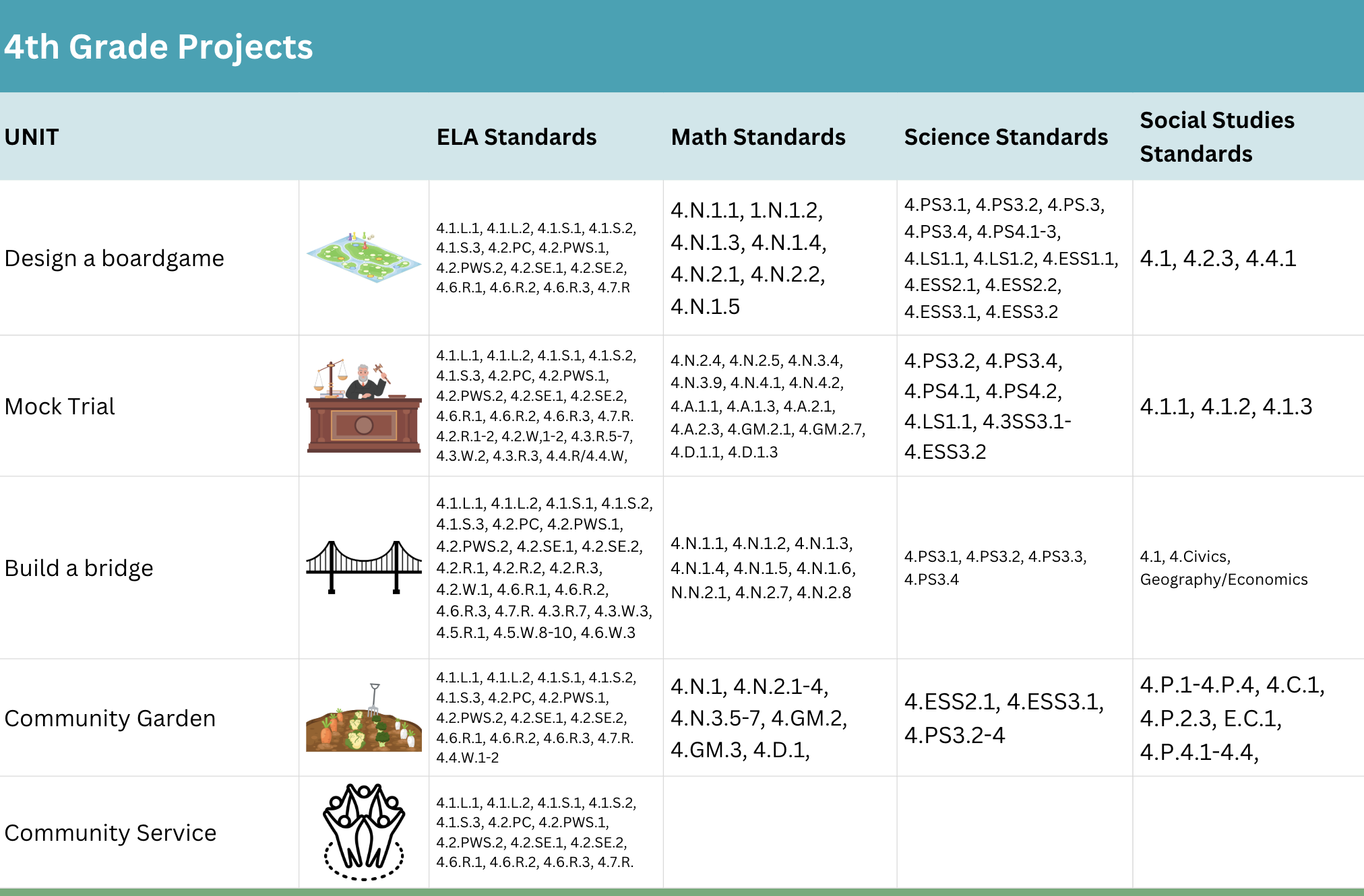
Standards-based curriculum designed by ONE Academy’s highly qualified educators will be in units of cross-curricular projects that give students a meaningful purpose to the standards they’re learning. All Oklahoma Standards are met through these units and overseen by highly qualified administrators. Standards will be assessed using regular benchmark assessments to meet student needs. An example 4th grade standards-aligned project-based curriculum will look like this:
In-Person Learning
Facilitated by certified educators
Teachers will guide regular lessons using an inquiry-based approach, provide online or supplemental instruction as needed, communicate with families, assess student progress, and facilitate experiential lessons that align with academic goals and standards.
Academic inquiry-based instruction occurs two times per week with peers and facilitated by teachers. Sessions last three hours each.
Hosted in ONE Academy’s facility, local parks, nature centers, libraries, and other accessible community spaces whenever possible. When not possible, virtual options will always be provided.
Lesson-aligned art embedded in the schedule.
Lesson-aligned music embedded in the schedule.
Students’ days are intentionally planned in order to provide structure and routine.
SELF Time
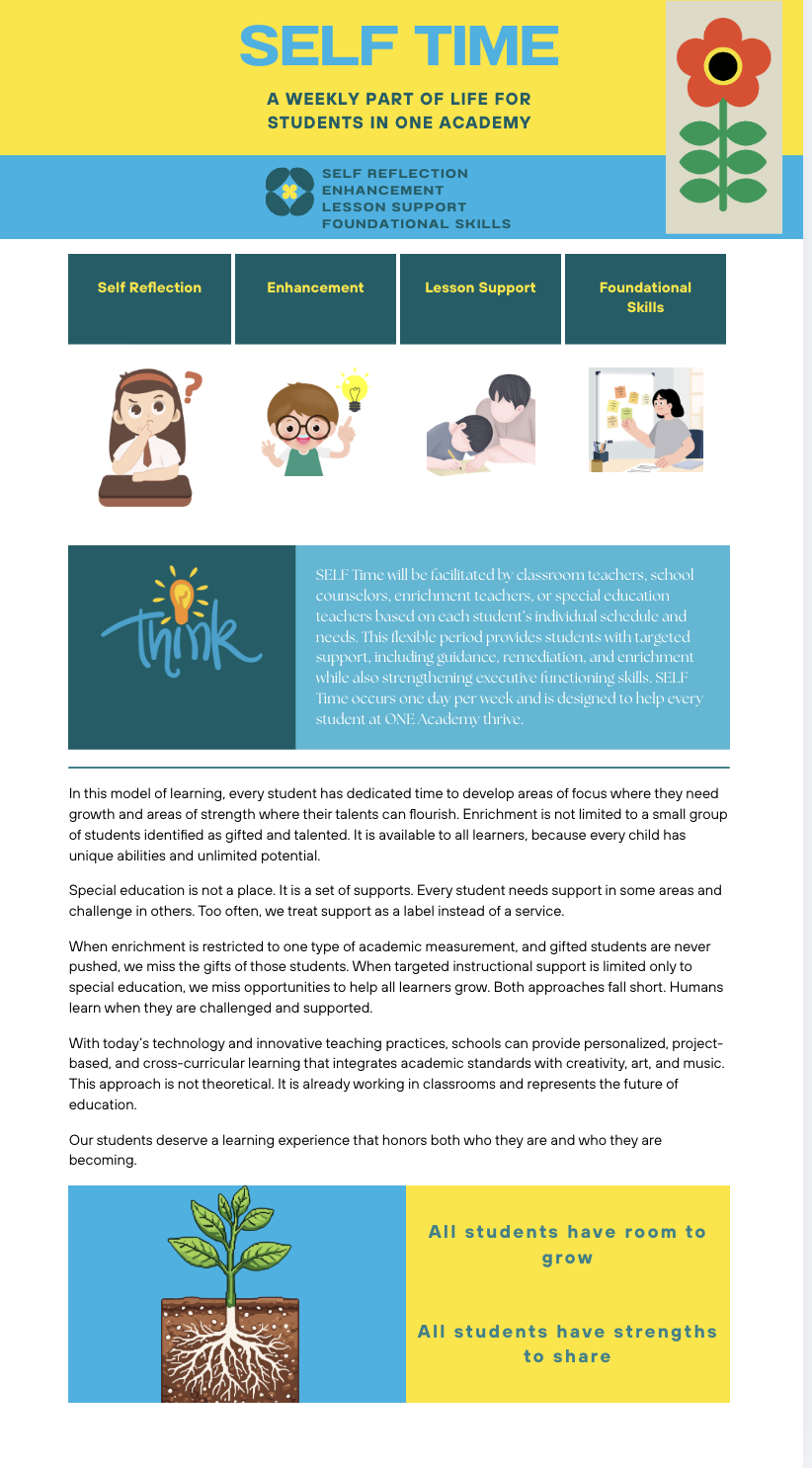
All students will have embedded SELF time in their weekly routine
Three Pillars of Connection
-
Self awareness and social confidence go hand in hand. Understanding how to plan, developing executive functioning skills, developing social skills, understanding how to identify emotions and having tools to deal with them are all part of ONE Academy’s SELF time. SELF is an acronym that stands for Self reflection, Enhanced learning, Lesson support, and Foundational skills. This is a flexible and intentional time for students to receive specific guidance, remediation, or enrichment depending on what they need in order to flourish, and is facilitated by teachers, counselors, special education teachers, gifted teachers, or other educators. These areas of development are grounded in years of study and experience with mental health and wellness practices, and are beneficial for all developing children. Gifted children will find goal areas and areas of strengths to build upon. Students with special needs will receive direct instruction in their areas of need. All students will explore personal interests, practice and plan social skills development, engage in mindfulness practices that are rooted in wellbeing, address behavior and emotional regulation concerns, discuss healthy tools for positive relationships, and build resilience and wellbeing with the guidance of trained educators.
-
Collaborative learning is woven throughout state and national standards for good reason: humans are innately social beings, and we learn best through interaction. The research is clear; children who lack meaningful social connection struggle academically, emotionally, and developmentally. The effects of pandemic-era isolation only reinforced what child development experts have long understood: social engagement isn't a supplement to learning. It is learning.
We are not simply brains in bodies. Movement, play, and human connection are fundamental to how children process and retain knowledge, build identity, and develop resilience. When students spend their days seated, isolated from the broader world, they miss something education cannot afford to ignore; a sense of belonging to something larger than themselves.
Community is not a backdrop to learning. It is one of its most powerful engines.
Research consistently links social belonging and peer collaboration to stronger academic outcomes, higher intrinsic motivation, reduced behavioral challenges, and greater long-term social mobility. But belonging doesn't happen by accident, it isn't produced by a daily recess period or a weekly group project. It is cultivated with intentionality, guided by educators and developmental specialists who understand what healthy connection looks like at every stage of growth.
At ONE Academy, social and community engagement are not extracurricular, they are core to our model.
Every student, at every grade level, will complete a standards-aligned community service project as a graduation requirement for each year of school. These projects are designed to meet academic goals while giving students real, meaningful ways to contribute to and connect with their community. As students advance, so does the depth of their involvement. By the time they reach high school, students are leading their own community-driven initiatives through entrepreneurship, internships, and industry partnerships, developing the skills, relationships, and sense of purpose that define a life well-lived.
-
Time spent in our natural world is currently reserved for select preschool students and adults with the privileges of having leisure time in between work days and who have access to natural spaces. The data on the impacts of time in nature to our mental and physical wellbeing is overwhelming and undeniable. This applies to preschoolers, yes. But it also applies to you and me, to 4th graders, 8th graders, the elderly, and everyone in between. The impacts of time in nature on mental wellbeing are profound alone, but data shows that it also leads to better cognitive function and academic outcomes in children.
For decades, US educators have been hearing about the schools in Finland and how effective they are, but struggling to find ways to integrate the Finnish model of education to the US’s economic and societal systems, but with modern technology and universal access, this type of platform has never been more available to our children.
At ONE Academy outdoor play and project-based learning are not just extracurriculars; they are integral to the way children understand the world and themselves. We prioritize our communities and nature as a co-teachers, using Oklahoma’s rich and diverse natural settings as living classrooms. Montessori-inspired, instructional time will be in person every day of the week and will be collaborative, relationship-focused, and hands-on, allowing for a break from the screens and making the teaching and learning process meaningful, restorative, and grounding for developing minds.
Students and their families will be given the choice to be issued a tablet that uses groundbreaking technology free of the damaging blue light for their virtual work.
Students will be incentivized to spend extra time outside playing and learning throughout their week, and families will be encouraged to enjoy the many health benefits of time in nature as an essential part of life. Students will learn in community spaces, parks and in our own forested space whenever possible, and students will learn that the entire world around them is a classroom, contributing to the habit and patterns of lifelong learning.
Connection is Key
We know through decades of research by Vygotsky and other educational pioneers that human beings learn through connection to one another. Educators have been sounding alarms for a decade on the increasing concerns around lagging social skills, increasing social anxiety, increasing dependence on adults, and decreasing abilities to confidently utilize resources within their communities. Students are suffering from complete disconnection from the tangible world around them. And yet, it is important for schools to recognize that technology is not all bad. In fact, technology increases access for so many students across the state of Oklahoma. It has the potential to foster some of the most innovative and profound ideas, increase our potential as humans, and is most certainly an integral piece of the future of our world. This increase in access to and use of technology in every area of our lives has benefits and also very apparent consequences that can be summed in one word: disconnection. ONE Academy’s three pillars of connection are pivotal to balancing the issues we’re seeing with educational technology use. To learn more about our Pillars of Connection, click on the dropdowns above next to each pillar.
Research Citations
Gillies, R. M. (2016). Cooperative learning: Review of research and practice. — Review summarizing mechanisms by which structured peer interaction improves learning (explanation, elaboration, feedback, motivation).ERIC
Vygotsky, L. S. — Sociocultural theory / social constructivism: foundational theoretical basis for why social interaction (peers and more knowledgeable others) supports cognitive development and learning. (Good conceptual citation for mechanism section.)Educational Psychology+1
Yu, X., et al. (2023). Academic achievement is more closely associated with student-peer relationships than with student–parent or student–teacher relationships in some samples. Frontiers in Psychology. — Cross-study evidence that peer ties are often especially important for school engagement and achievement.Educational Psychology+1
Roseth, C. J., Johnson, D. W., & Johnson, R. T. (2008). Promoting early adolescents’ achievement and peer relationships: The effects of cooperative, competitive, and individualistic goal structures. Psychological Bulletin, 134, 223–246. — Meta-analysis showing cooperative peer structures reliably improve achievement and peer relationships compared with competitive/individualistic structures.PubMed
Kindermann, T. A. (2007). Effects of naturally existing peer groups on changes in academic engagement in a cohort of sixth graders. Child Development, 78(4), 1186–1203. — Longitudinal evidence that naturally occurring friendship groups shape changes in classroom engagement (selection and influence effects).PubMed
Véronneau, M.-H., Vitaro, F., Brendgen, M., & Dishion, T. J. (2011). Middle school friendships and academic achievement: A longitudinal social network perspective. (See review / results showing friends’ characteristics predict change in achievement across grades.) — Friends’ academic orientations predict students’ later achievement.PMC
Shao, Y., et al. (2024). How peer relationships affect academic achievement among junior high students: mechanisms via motivation and engagement. BMC Psychology. — Recent study showing peer relationships influence achievement both directly and via increased learning motivation and engagement.BioMed Central
Chen, C., et al. (2023). The relationship between social support and academic engagement. BMC Public Health. — Demonstrates social support (including peers) predicts greater academic engagement, a mediator of achievement.BioMed Central
Behavioural Insights Team & collaborators (2025 reporting): Economic connectedness and later social mobility — Large population work showing cross-class friendships formed in schools (connectedness) predict long-term positive outcomes (useful if you want an equity/social mobility angle). (Press coverage / synthesis).The Guardian+1
Alotaibi, T. A. (2023). The benefits of friendships in academic settings. PMC/NIH review — concise review linking friendships to reduced stress, greater well-being, and higher GPA.PMC
Jimenez et al., Associations between Nature Exposure and Health — comprehensive review linking green-space exposure with reduced emotional/behavioral problems and better mental health across ages.PMC
Tillmann et al., Mental health benefits of interactions with nature in children and teenagers (JECH) — review summarizing evidence that nature contact is associated with better mental health in youth.J Epidemiol Community Health
Pediatrics (AAP) Nature and Children’s Health: A Systematic Review (2021) — authoritative paediatric review: nature contact benefits children’s mental health, physical activity, and developmental outcomes.Pediatrics
Towe-Goodman et al., Green space & internalizing/externalizing symptoms (JAMA Network Open, 2024) — cohort evidence from the NIH ECHO consortium linking residential greenspace to fewer internalizing/externalizing symptoms in early/middle childhood.JAMA Network
Patchen et al., Supporting children's wellbeing through outdoor time (2024 Frontiers) — synthesis focused on cognitive, psychological, and academic benefits of childhood outdoor time.Frontiers
Owens et al., Brief virtual nature exposure improves adolescent mood & attention (2023) — shows short nature exposures (even virtual) can reduce stress and improve attention in teens (experimental evidence).Nature
Child development outcomes: Residential or school access to green space is linked to fewer internalizing/externalizing symptoms and cognitive benefits for children.JAMA Network+1
Fan, M. S., et al. (2025). Nature-based interventions for enhancing resilience in children (review, PMC) https://pmc.ncbi.nlm.nih.gov/articles/PMC6546608/?utm_source=chatgpt.com
Sign Up to Learn More
ONE Academy has an enrollment capacity of 300 students. If you are interested in more information or would like to stay informed, please enter your information here and you will receive updates and be one of the first to know when the enrollment window opens.